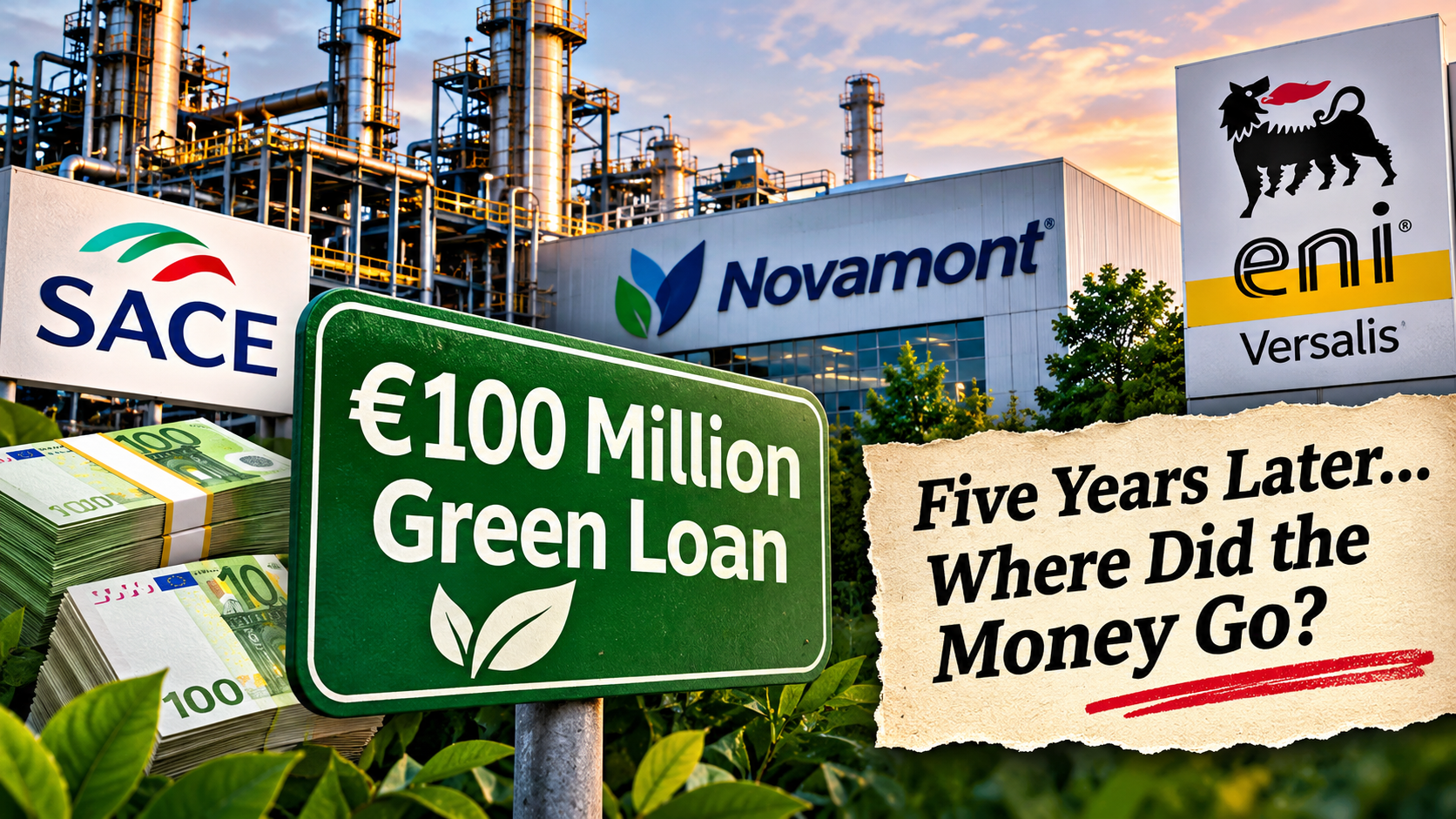
In 2021, Novamont secured €100 million from four major banks, backed by an 80% SACE green guarantee. The money was intended to support industrial expansion and the transition to a circular bioeconomy. Five years later, what can the public establish about the investments, the repayments and the financial risk?
1. €100 Million for a Greener Future
On October 14, 2021, Italian bioplastics producer Novamont announced an ambitious financing agreement. The company had secured a €100 million loan, supported by a green guarantee from SACE, Italy’s publicly controlled export-credit and financial-support institution.
The financing was provided by four major banks: Crédit Agricole Italia, acting as agent bank; Banco BPM; Intesa Sanpaolo; and UniCredit. SACE guaranteed 80% of the financing, corresponding to €80 million of initially guaranteed principal.
The announcement formed part of Italy’s Green New Deal financing framework, intended to support industrial investments contributing to environmental sustainability and the transition toward a lower-carbon economy.
Novamont explained that the financing would support its 2021–2025 investment plan, expand bioplastics production capacity and strengthen its competitive position in Europe, North America and Asia. The company presented the operation as an important step in developing a more sustainable chemical industry.
The announcement was positive, ambitious and widely publicised. But financial agreements have two sides: the promises made when the money arrives, and the results delivered afterward. Five years later, it is reasonable to ask what happened to this €100 million financing.
2. Who Actually Provided the Money?
The first distinction is essential. SACE did not simply hand Novamont €100 million of taxpayers’ money. The financing was provided by commercial banks. SACE supplied a guarantee covering 80% of the loan under the terms of its green financing arrangement.
In practical terms, a guarantee protects the lenders against specified losses if the borrower fails to meet its obligations. The arrangement involved three principal parties: Novamont, the borrower responsible for repayment; the four banks, which provided the funds; and SACE, which assumed a substantial portion of the defined credit risk.
A public guarantee is not the same as a subsidy, nor does it automatically result in public expenditure or loss. If Novamont repays according to its contractual terms, there may be no claim under the guarantee. If the borrower defaults, the guarantee could become relevant, subject to the applicable conditions and remaining guaranteed exposure.
This is precisely why the repayment status matters. The original €80 million guaranteed amount does not tell us what SACE’s exposure is today. That depends on the loan’s outstanding principal, repayments, possible refinancing and the continuing validity of the guarantee.
3. What Was the €100 Million Supposed to Finance?
Novamont’s October 2021 announcement linked the loan to its industrial investment programme for 2021–2025: increase bioplastics production capacity, strengthen international competitiveness and develop a more circular industrial model.
However, the announcement did not provide an investment-by-investment allocation of the €100 million. It did not identify how much would be spent at Terni, Patrica, Bottrighe or other Novamont facilities, nor a public timetable specifying new capacity at each site using this particular financing.
There is a substantial difference between announcing a financing package intended to support an investment programme and demonstrating exactly which investments were financed by it.
Novamont Was Already Investing Before the Loan
Novamont was not an industrial newcomer when the agreement was signed. The company had already developed production infrastructure at several Italian sites.
In October 2019, Novamont announced that its Mater-Bi production capacity had reached approximately 150,000 tonnes annually, following developments at Terni and Patrica. The Patrica project alone had involved more than €100 million of investment, according to Novamont. Those investments predated the October 2021 SACE-backed financing and cannot simply be presented as its outcome.
In December 2020, Intesa Sanpaolo announced a separate €20 million circular-economy loan for two Novamont projects involving Terni and Bottrighe. That agreement was more specific about its intended projects, including bio-based chemical production and upgrading biogas from fermentation residues.
The €20 million operation was separate from the later €100 million SACE-backed financing. Identifying an investment completed by Novamont during this period does not automatically establish that it was financed through the SACE arrangement. Following the €100 million accurately requires distinguishing the financing facilities and their respective investment programmes.
4. The Green Performance Conditions
One of the most interesting aspects of the 2021 agreement concerns environmental performance. According to Novamont’s announcement, the financing took account of the company’s performance against a minimum threshold of its Indice dei Flussi Circolari, or Circular Flows Index.
This indicator was associated with fatturato rigenerativo, or regenerative turnover: broadly, the proportion of company revenue associated with activities considered circular, including renewable materials, certified biodegradable or compostable products, and recovered resources.
Who verified the Circular Flows Index? What threshold was applied? Were the indicators monitored throughout the financing period? Did the contractual arrangements provide for consequences if environmental performance deteriorated? What environmental results were achieved through the investments?
The original announcement provides the rationale for the sustainability criteria, but not a complete public record of subsequent monitoring. This does not mean that monitoring did not take place. The information may be available to the banks and SACE without being included in public announcements. Where environmental performance forms part of the justification for publicly guaranteed financing, disclosure of measurable outcomes would help establish whether the arrangement achieved its objectives.
5. What Did Novamont Actually Invest?
Novamont’s 2021 Sustainability Report provides evidence of industrial activity following the financing announcement. The company reported approximately €50 million invested in industrial and research activities during 2021, and described developments in its industrial operations and bio-based chemical production.
These disclosures demonstrate significant investments during the period. However, that €50 million cannot automatically be attributed to the SACE-backed loan. Novamont had other financing arrangements, investment commitments and sources of liquidity.
Money borrowed through a corporate financing facility can enter broader treasury arrangements, making its ultimate allocation difficult to reconstruct without detailed accounting information.
The question is not whether Novamont invested money. It clearly did. The question is whether Novamont, SACE or the financing banks can provide a reconciliation identifying the investments associated with the €100 million operation and their eventual results: amounts, project locations, completion dates, production capacity added and measurable environmental outcomes.
6. Then ENI Acquired Novamont
On October 18, 2023, Versalis, ENI’s chemical subsidiary, completed its acquisition of the remaining 64% of Novamont, having previously held 36%.
According to ENI’s 2023 annual report, the consideration for the remaining 64% was approximately €404 million, with acquisition accounting also reflecting the assumption of Novamont’s net financial liabilities.
The ownership change matters because the financing had been granted before ENI obtained full control. Once the acquisition was completed, Novamont became a wholly controlled member of the ENI group through Versalis.
Was the SACE-backed loan left unchanged? Did the acquisition trigger contractual review? Was the facility refinanced, prepaid or incorporated into wider group financing? Did ENI provide additional support or guarantees?
The available acquisition announcements do not establish the answers for this particular €100 million facility. The acquisition did not necessarily discharge the debt or terminate SACE’s guarantee; equally, the original arrangement did not necessarily remain unchanged. Its treatment must be established from loan and accounting records.
7. The Commercial Reality in 2025
By 2025, the industrial and economic environment had changed considerably. ENI’s 2025 annual report describes substantial challenges in its chemical activities, including weak demand, high production costs and international competition.
ENI’s chemical business recorded a non-GAAP operating loss of approximately €819 million in 2025, compared with €814 million in 2024. These are figures for the broader chemicals business, not a measure of Novamont’s €100 million loan.
The same annual report gives more specific figures: Novamont contributed approximately €271 million of biochemistry revenue in 2025, while Novamont Group sales volumes declined by 7.4% versus 2024, alongside a reduction in revenue.
These figures show commercial pressure despite earlier investment ambitions. But declining sales volumes do not prove investments failed or loan proceeds were misused. Capacity can be completed without reaching intended utilisation in a weak market. Evaluating the financing requires project-level evidence, not just revenue comparisons.
8. Has the €100 Million Been Repaid?
Perhaps the most straightforward question is: What is the outstanding principal of the original €100 million SACE-backed financing?
The 2021 announcement does not disclose a detailed repayment schedule, interest rate or final maturity date. In examining publicly accessible announcements and available corporate reporting, Bioplastics News has not established a verified, loan-specific statement confirming whether the financing has been fully repaid.
Nor has it established cumulative principal repaid, whether the facility was refinanced, or whether SACE made any payment under the guarantee. This is an important limitation.
The absence of a readily identifiable repayment disclosure is not evidence that Novamont failed to repay. The loan may have been serviced according to schedule, repaid early, refinanced or amended. Individual borrowing facilities are not always separately identifiable in consolidated financial statements, and commercially sensitive terms may not be disclosed publicly.
Nevertheless, for a financing operation promoted with an €80 million public guarantee, there is a public-interest argument for making its current status understandable. The original maturity date, principal repaid, outstanding balance and current SACE guarantee status could resolve much of the uncertainty.
9. Public Guarantees Deserve Public Accountability
There is nothing inherently improper about SACE guaranteeing financing for an industrial company. Public financial institutions can support investment that produces economic, industrial or environmental benefits, and guarantees can improve access to funding.
But support and accountability should go together. In 2021, the intended benefits were publicly explained. By November 2026, the announced 2021–2025 investment period had ended. It is therefore reasonable to seek a retrospective assessment.
What additional industrial capacity was created? Which investments were completed? How did they perform? Were environmental criteria satisfied? What became of the original credit exposure? These are ordinary questions of financial and industrial accountability, not allegations of wrongdoing.
10. Questions for SACE, Novamont and ENI
- What was the original contractual maturity date of the €100 million loan?
- How much principal has been repaid, and what remained outstanding in November 2026?
- Was the financing amended, refinanced or prepaid following ENI’s 2023 acquisition?
- Does the original SACE guarantee remain in force, and what exposure remains?
- Has any guarantee claim been submitted or payment made?
- Which specific projects received financing attributable to the operation?
- What additional production capacity and measurable industrial results were achieved?
- Which environmental performance indicators applied, and how were they monitored?
- Where can the public find a retrospective assessment of the loan’s economic and environmental outcomes?
Some details may be subject to commercial confidentiality. Others may exist in reports not identified in the available public disclosures. The objective is to establish what can be documented.
11. Where Did the Money Go?
Five years after the announcement, the question is not whether public guarantees are inherently good or bad, nor whether subsequent losses in ENI’s chemicals business prove the financing was unsuccessful. Neither conclusion follows from the available evidence.
In October 2021, a major Italian industrial company obtained €100 million of bank financing backed by an €80 million SACE guarantee, associated with ambitious expansion and environmental commitments. By the end of 2025 the investment period had concluded.
Yet the information examined for this article does not permit a complete, loan-specific reconstruction of the proceeds, financed projects, outcomes and repayment position. That information gap is worth addressing.
Novamont’s €100 million financing deserves precisely that examination. Not because the available evidence proves the money disappeared. It does not. But because public guarantees, industrial promises and financial accountability should be considered together.
Five years later, the most useful answer is simple: what was financed, what was delivered, what has been repaid, and what financial exposure, if any, remains.
Editorial Note — Bioplastics News
In the world of green industrial finance, announcing €100 million is excellent publicity. Explaining what happened to it five years later is considerably less glamorous. Public guarantees deserve more than celebratory press releases. They deserve understandable follow-up reporting.
Bioplastics News welcomes relevant financial disclosures, factual corrections and explanations from SACE, Novamont, ENI and the financing banks.
Disclaimer
This article is an independent journalistic examination of publicly announced financing arrangements and available corporate disclosures. It does not allege fraud, misappropriation, default, unlawful state aid or improper conduct by any organisation or individual. The original €100 million financing was a bank loan supported by a SACE guarantee, not a €100 million government grant. The €80 million initially guaranteed principal does not represent an established public loss. Where use of proceeds, repayment or guarantee status could not be independently established from the materials examined, that uncertainty is explicitly identified. Absence of publicly identified information is not evidence of non-compliance or wrongdoing.
Sources and Documents
- Novamont — SACE and banking consortium financing announcement, October 14, 2021: https://www.novamont.it/leggi-comunicato-stampa/sace-insieme-a-un-pool-di-primarie-banche-per-la-crescita-di-novamont/
- UniCredit — Confirmation of the €100 million financing, 2021: https://www.unicreditgroup.eu/it/press-media/press-releases/2021/sace-insieme-a-un-pool-di-primarie-banche-per-la-crescita-di-nov.html
- Novamont — Sustainability Report 2021: https://www.novamont.it/public/Bilancio%20di%20sostenibilit%C3%A0/Novamont_Sustainability%20Report%202021%20%28NFS%29.pdf
- Intesa Sanpaolo — Separate €20 million circular-economy financing, December 2020: https://group.intesasanpaolo.com/en/newsroom/press-releases/2020/12/intesa-sanpaolo-and-novamont–20-million-euro-circular-loan-agre
- Novamont — Mater-Bi production expansion, October 2019: https://novamont.com/eng/read-press-release/novamont-increases-mater-bi-production-to-150000-tonnes/
- ENI — Completion of Novamont acquisition, October 2023: https://www.eni.com/en-IT/media/press-release/2023/10/versalis-acquisition-of-novamont-completed.html
- ENI — Annual Report on Form 20-F, 2023: https://www.eni.com/content/dam/enicom/documents/eng/reports/2023/Annual-Report-On-Form-20-F-2023.pdf
- ENI — Annual Report on Form 20-F, 2025: https://www.eni.com/content/dam/enicom/documents/eng/reports/2025/ar-2025/Annual-Report-On-Form-20-F-2025.pdf
BioplasticsNews.com — November 23, 2026.
Leave a Reply