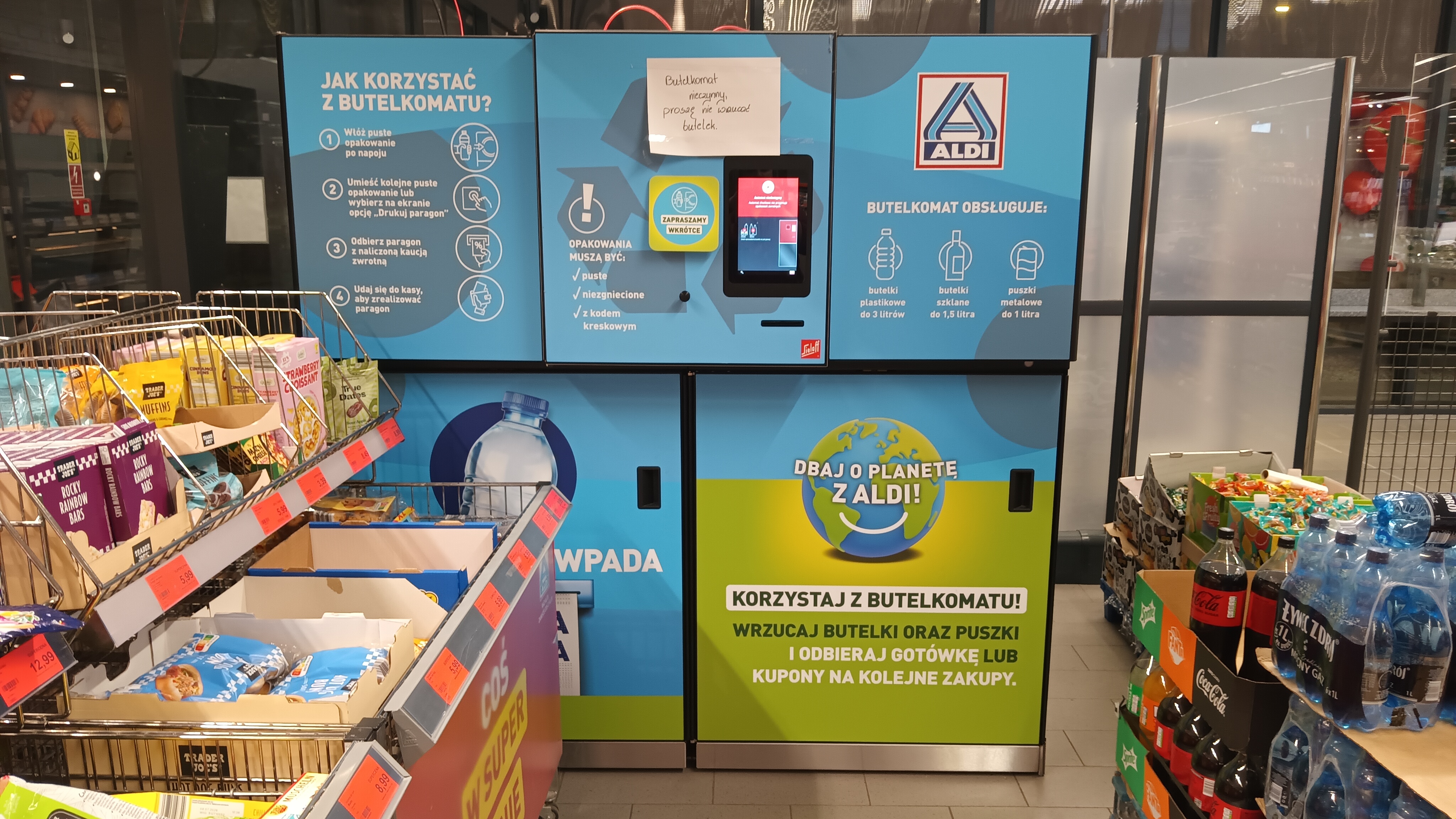
Poland’s beverage-container deposit system has collected billions of bottles and cans during its first year. Yet a parliamentary proposal seeks to abolish it, while consumer complaints and questions about implementation continue to fuel controversy.
Poland’s Recycling Revolution Faces Political Opposition
Poland’s deposit-return system is facing a political challenge just over a year after its introduction. A parliamentary bill submitted by lawmakers from the Confederation (Konfederacja) political grouping proposes the abolition of the scheme that began operating on 1 October 2025.
The proposal, registered as Sejm document No. 3310, would repeal the legal framework governing deposits, collection obligations and system operators. It was referred for first reading in November 2026.
But an important distinction must be maintained: the proposal has not been adopted, and Poland’s deposit-return system remains in operation.
The Polish Ministry of Climate and Environment reports that approximately five billion deposit-bearing containers were returned during the system’s first year. Why would politicians propose abolishing a programme the government presents as a success? The debate encompasses consumer convenience, collection costs, accessibility and the economics of recycling.
How Poland’s Deposit System Works
Introduced nationwide on 1 October 2025, the scheme covers single-use plastic beverage bottles up to three litres, with a PLN 0.50 deposit; metal beverage cans up to one litre, also at PLN 0.50; and reusable glass beverage bottles up to 1.5 litres, with a PLN 1 deposit.
Consumers pay the deposit when purchasing eligible products and recover it by returning empty packaging to authorised collection points. Many retailers have installed reverse vending machines, known in Poland as butelkomaty, which scan and accept eligible containers.
Unlike conventional household waste collection, a deposit-return system creates a dedicated channel for specific packaging materials. For PET bottles, that can produce a relatively clean and identifiable stream of recyclable plastic.
Five Billion Returns: Success or an Incomplete Picture?
The Polish government reported significant growth in collected packaging volumes. In August 2026, the ministry announced that roughly 3.2 billion containers had been collected since the launch, with more than 60,000 return points, including approximately 17,500 reverse vending machines.
By October, the reported cumulative total had reached five billion containers. These figures indicate substantial participation and growing collection activity.
Yet five billion returned containers is not the same as a verified collection rate, actual recycling rate or environmental-impact assessment. To assess effectiveness, we also need the number and weight of eligible containers placed on the market, the share recovered, material quality and the fate of the collected packaging.
A plastic bottle returned to a machine does not automatically become a new food-grade PET bottle. Sorting, processing, contamination, losses and demand for recycled materials all influence the eventual outcome.
Why Does the Opposition Want to Abolish the System?
The Confederation-backed proposal argues that the deposit system creates unnecessary inconvenience for consumers and administrative burdens for businesses. Its justification raises concerns about storing and returning containers, reverse-vending-machine problems and the potential loss of deposits when consumers cannot or do not return eligible packaging.
The sponsors also question whether more conventional collection and purchasing arrangements could achieve comparable environmental objectives. These are arguments advanced by the bill’s proponents, not independently established evidence that the system is ineffective.
A refundable deposit is not automatically a tax or permanent charge. But when returning a container is impractical, an unredeemed deposit can represent a real expense for the consumer. Accessibility and reliable refunds therefore matter.
Consumer Complaints and Accessibility Problems
Poland’s Commissioner for Human Rights has raised concerns about whether the scheme adequately accommodates people who have difficulty returning packaging, including older people, people with disabilities and residents of communities with limited access to collection points.
A system can be effective at recovering containers yet remain inconvenient for particular groups. Such concerns do not automatically justify abolition, but they merit attention in any assessment of the programme.
The environment ministry has itself discussed potential improvements, including work on the validity period of deposit vouchers. The practical question is whether operating problems should be corrected through reforms or addressed by a different collection model.
The European Union Complication
Poland’s scheme operates within a wider EU legislative framework. European rules establish separate-collection objectives for single-use plastic beverage bottles, while the Packaging and Packaging Waste Regulation (EU) 2025/40 adds requirements relating to collection and deposit-return systems.
The EU framework generally establishes a 90% separate-collection objective for relevant single-use plastic beverage bottles and metal beverage containers by 2029, with conditional exemptions relating to deposit-return schemes where the applicable criteria are met.
Removing Poland’s current scheme would therefore raise important questions about how the country would achieve its European collection obligations. Abolishing a deposit system does not abolish EU packaging-collection requirements.
What Would Abolition Mean for the Plastics Industry?
For PET recyclers, a functioning deposit system can be a valuable source of relatively clean beverage packaging. Dedicated collection helps separate eligible bottles from more heavily contaminated mixed municipal waste streams, which can be important for applications requiring consistent material quality.
Replacing or dismantling the scheme could affect logistics, material availability, contracts and infrastructure investment. But the consequences depend on what would replace it: abolition would not automatically end PET recycling, and existing municipal systems cannot simply be assumed to deliver identical results without additional costs.
A transparent assessment should ask: How much does the scheme cost? What percentage of eligible packaging is collected? How much is actually recycled into usable material? What revenue comes from recovered commodities? And how does that compare with the alternatives?
Recycling More Plastic Does Not Necessarily Mean Using Less Plastic
Deposit-return schemes primarily aim to improve collection and, where applicable, reuse. They do not necessarily reduce the number of plastic beverage containers sold. A programme can collect billions of PET bottles while producers continue placing enormous quantities of single-use packaging on the market.
This does not make improved collection meaningless. It means collection efficiency and total plastic consumption are separate environmental indicators.
The same caution applies to bio-based and supposedly biodegradable packaging: alternative feedstocks and marketing claims do not automatically establish better environmental performance. Real end-of-life outcomes and lifecycle impacts still matter.
Will Poland Reform or Abolish the System?
As of 24 November 2026, Poland’s deposit-return system remains in force and the proposal to abolish it has not become law. Official figures indicate billions of containers returned and a substantially expanded collection network.
The emerging debate involves different considerations. Supporters emphasise container recovery and cleaner recycling streams. Critics cite operating costs, inconvenience and administrative burdens. The question is not simply whether Poland should collect plastic bottles, but whether its current system is the most effective, accessible and economically defensible means of doing so.
Editorial Note — Bioplastics News
Five billion containers returned in one year. It sounds impressive, and the scale of collection certainly deserves attention. Yet some Polish politicians want the deposit system abolished.
One side points to billions of bottles and cans collected. The other points to inconvenience, costs and bureaucracy. Perhaps the useful question is whether the scheme delivers measurable environmental benefits at a cost that consumers, retailers and society can reasonably sustain.
Collecting five billion containers is not the end of the recycling story. It is only the beginning of the accounting.
Disclaimer
This article is based on publicly available Polish parliamentary records, government announcements, regulatory documents and industry reporting available as of 24 November 2026. The proposal to abolish the deposit-return system has not been enacted; criticisms are attributed to its sponsors and do not constitute verified findings that the system is ineffective. Official collection figures describe reported returns, not necessarily audited recycling rates or proof of overall environmental performance. The article does not endorse any political party or legislative initiative.
Sources
1. Polish Parliament — Bill No. 3310 proposing abolition: https://api.sejm.gov.pl/sejm/term10/prints/3310/3310.pdf
2. Polish Parliament — Legislative progress for Bill 3310: https://www.sejm.gov.pl/Sejm10.nsf/PrzebiegProc.xsp?nr=3310
3. Ministry of Climate and Environment — Five billion returns, October 2026: https://www.gov.pl/web/klimat/5-mld-opakowan-w-12-miesiecy-system-kaucyjny-rozwija-sie-w-ekspresowym-tempie
4. Ministry of Climate and Environment — 3.2 billion returns, August 2026: https://www.gov.pl/web/climate/32-billion-packaging-items-collected-and-work-begins-on-extending-the-validity-of-the-deposit-voucher
5. Ministry of Climate and Environment — Deposit system guidance: https://www.gov.pl/web/climate/deposit-refund-system-in-poland
6. Polish Commissioner for Human Rights — Accessibility concerns: https://bip.brpo.gov.pl/pl/content/rpo-mkis-system-kaucyjny
7. Plastics Information Europe — Deposit scheme parliamentary challenge, 24 November 2026: https://pieweb.plasteurope.com/default.aspx?node=100277&pageid=302
8. European Union — Packaging and Packaging Waste Regulation (EU) 2025/40: https://eur-lex.europa.eu/eli/reg/2025/40/oj
Featured photograph: Bottle receiving machine at Aldi Nord in Tomaszów Mazowiecki, Poland, by WrS.tm.pl, public domain. Source: Wikimedia Commons.