
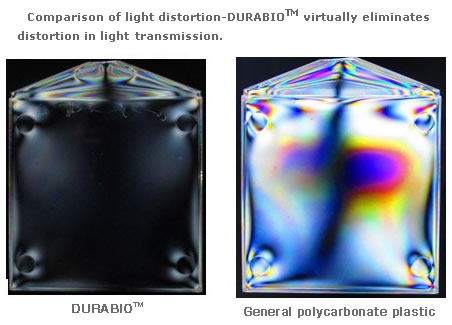
Mitsubishi Chemical Corporation (Japan) recently announced the development of a new grade of high-performance, high-transparency bio-based engineering plastic called DURABIO™, using plant-derived isosorbide as its raw material.
The new material features excellent optical properties and high resistance to heat and humidity.
Mitsubishi is thus another example, along with Roquette in Europe, to propose isosorbide based resins for high transparency and high resistant materials like TV and smartphone screens, touch panels and dashboard screens.
MCC will move aggressively to promote sales of DURABIO™ for use in touch panels on automobiles, a sector where demand is expected to increase significantly.
In contrast to easily breakable glass, transparent plastics such as impact-resistant polycarbonate, are used for the front plate of automobile touch panels for safety purposes.
The disadvantage of polycarbonates, however, is distortion in light transmission, which makes it difficult for users to see the touch panel, so a material that could overcome this problem has been eagerly awaited.
MCC’s new grade of DURABIO™ features excellent optical properties, and nearly eliminates distortion in light transmission, making it easy to see the touch panel surface.
Since end of 2012, MCC is producing DURABIO™ at its Kurosaki plant with an annual production capacity of 5,000 tons and announced a plan to increase this capacity to 16,000 tons by year 2015.
INTERNAL LINKS
EXTERNAL LINKS
Leave a Reply to FDCA boosted by BASF and Avantium – The JV Project – Bioplastics NewsCancel reply