
Despite growing efforts to improve plastic waste management, significant gaps remain. In 2019, 19% of food and beverage plastic packaging waste in Europe was still sent to landfill, while 39.5% was incinerated for energy recovery—both far from the ideal circular economy model. While recycling is often seen as a solution, it presents major limitations:
- Mechanical recycling degrades plastic properties over time, making the material less suitable for high-performance applications after multiple cycles.
- Chemical recycling, which breaks plastics down at the molecular level, is energy-intensive, slow, and currently underutilized, with only 2% of plastic waste undergoing this process.
upPE-T: A Novel Approach to Upcycling Plastic Waste
To address these challenges, upPE-T proposes an innovative approach to upcycling post-consumer PE and PET packaging waste into biodegradable and recyclable bioplastics (PHBVs) for food and beverage packaging. Unlike traditional recycling methods, this process converts plastic waste into high-value, sustainable materials, aligning with the principles of a circular economy. However, ensuring its environmental sustainability requires rigorous assessment. This is where Life Cycle Assessment (LCA) methodology plays a crucial role.
The Role of Life Cycle Assessment (LCA) in Process Evaluation
LCA is a systematic approach used to quantify the environmental impacts of a product or process across its entire life cycle, from raw material extraction to disposal. By applying LCA to the upPE-T process, we aimed to:
- Assess its sustainability compared to existing recycling methods (e.g., mechanical recycling).
- Identify major contributors to environmental impact (such as energy use and chemical inputs).
- Guide process optimization to ensure scalability while minimizing environmental trade-offs.
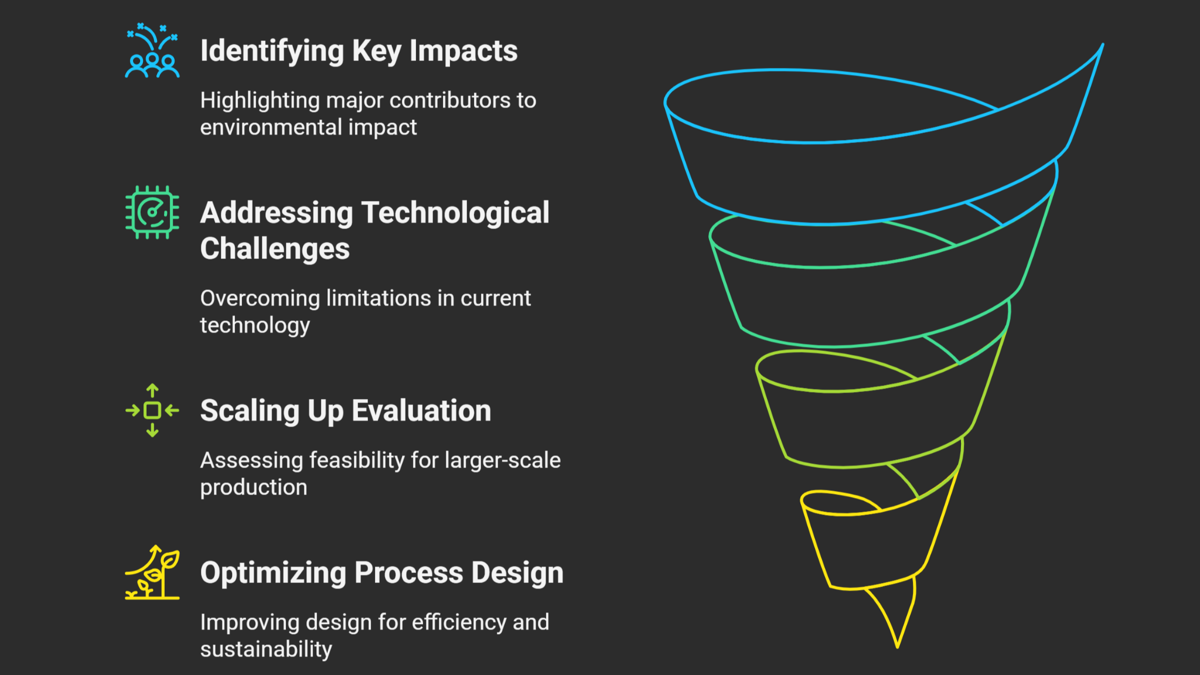
However, due to technological limitations, the LCA was conducted only on the PET treatment process. While upPE-T also aims to upcycle PE waste, the technological advancements for PE processing were not yet sufficient to conduct even a preliminary analysis. This means that the current sustainability evaluation focuses solely on PET treatment, and future studies will need to integrate PE process assessments as the technology matures. Figure 1 highlights the critical stages in evaluating Life Cycle Assessment challenges.

Figure 1: Challenges in Life Cycle Assessment in novel upcycling technology.
Challenges at the Laboratory Scale
A preliminary LCA was conducted to gain an initial understanding of the environmental feasibility of the upPE-T PET treatment process. In this assessment, the functional unit was defined as 100 grams of PET treated, with an estimated PHBV production ranging between 5 and 10 grams. The system boundaries encompassed multiple process steps; however, only a partial analysis could be performed due to the ongoing development of biological processes.
The initial results revealed a high environmental impact, largely attributed to electricity consumption. At the laboratory scale, equipment requires a substantial amount of energy, while the actual material output remains relatively low. As a result, the energy demand appears disproportionately high when normalized to the functional unit. However, as the process scales up, energy efficiency is expected to improve, ultimately reducing its overall environmental impact.
Scaling Up: Estimating Industrial Feasibility
To assess the potential of large-scale production, a higher-scale evaluation was conducted, envisioning a 400 kg per day PHBV production capacity. Given that the current assessment is based on only 4 kg of PHBV, this larger-scale scenario required estimating input values rather than relying on direct measurements. While this provided a necessary first step in evaluating industrial feasibility, it also introduced several new limitations and challenges.
One of the biggest challenges was fragmented data collection. Each step of PET degradation is carried out in different laboratories, making it difficult to track inputs consistently. This lack of centralized data means sustainability assessments rely on aggregated data rather than direct measurements, introducing uncertainties that need to be addressed in future iterations.
Another key challenge was the transition from batch to continuous processing. At this stage, the process operates in batch reactors, where each reaction cycle runs for around 24 hours before restarting. While suitable for small-scale production, this approach is not practical for industrial-scale implementation. Future development will require a shift to continuous plug-flow reactors, where materials move through the system without interruption. This transition is expected to significantly enhance efficiency, reduce energy consumption, and optimize resource use, but its full sustainability benefits have yet to be quantified.
Additionally, chemical demand emerged as a critical challenge when evaluating large-scale feasibility. Preliminary estimates indicated that producing 400 kg of PHBV per day would require enormous quantities of key chemicals. For instance, the estimated sodium hydrogen phosphate demand reached nearly 90 tons, an amount disproportionate to the expected PHBV output. This highlights the urgent need for process optimization, as such high material requirements could pose serious economic and environmental barriers at an industrial scale.
Addressing LCA Database Limitations
Another limitation encountered during the LCA study was database constraints. The Ecoinvent database, widely used for environmental impact assessments, includes an extensive range of industrial processes but does not contain all the specific chemicals and microorganisms used in the upPE-T process. To address this, substitutions were made where possible, selecting functionally similar chemicals available in the database. However, in some cases, substitutions were not feasible, meaning that certain key inputs were omitted from the analysis. This introduces gaps in the assessment, reducing the accuracy of the results.
Moving Forward: Optimizing the Process for Industrial Implementation
Despite these challenges, this large-scale assessment provides a crucial foundation for refining the upPE-T process and ensuring its long-term viability. Moving forward, future iterations of the LCA will need to incorporate real-world production data to improve the accuracy of sustainability assessments. Additionally, optimizing chemical inputs and enhancing energy efficiency will be essential to minimizing the environmental impact of large-scale production. Another critical step will be advancing the process design from batch reactors to continuous operation, which is expected to significantly improve efficiency and resource utilization.
Transitioning from a theoretical model to a validated, scalable process is both complex and necessary to establish upPE-T as a genuinely sustainable alternative to conventional plastic recycling methods. By continuously improving the process through LCA-driven optimization, upPE-T has the potential to make a meaningful contribution to the development of a circular and resource-efficient plastic economy.
Acknowledgement
The research leading to the results presented in this paper has received funding from the European Union funded Project upPE-T under grant agreement no 953214.

Author
The text was provided by Digiotouch: Maria Aiello and Debolina Paul Digiotouch OU, Tallinn, Estonia
Leave a Reply