
Every year, over 70 million tons of polyethylene terephthalate (PET) are produced globally, primarily for packaging. While PET’s durability makes it indispensable, its resistance to degradation has turned it into one of the most persistent environmental challenges. Conventional mechanical recycling degrades polymer quality over time, limiting how often PET can be reused. Chemical recycling offers a way to regenerate PET at high quality but remains energy-intensive and costly.
The EU Horizon 2020-funded upPE-T Project takes a different approach—not just recycling PET into new PET, but upcycling plastic waste into biodegradable materials. By integrating enzymatic PET hydrolysis with microbial fermentation, the project explores the potential of converting PET waste into polyhydroxybutyrate-valerate (PHBV), a compostable bioplastic.
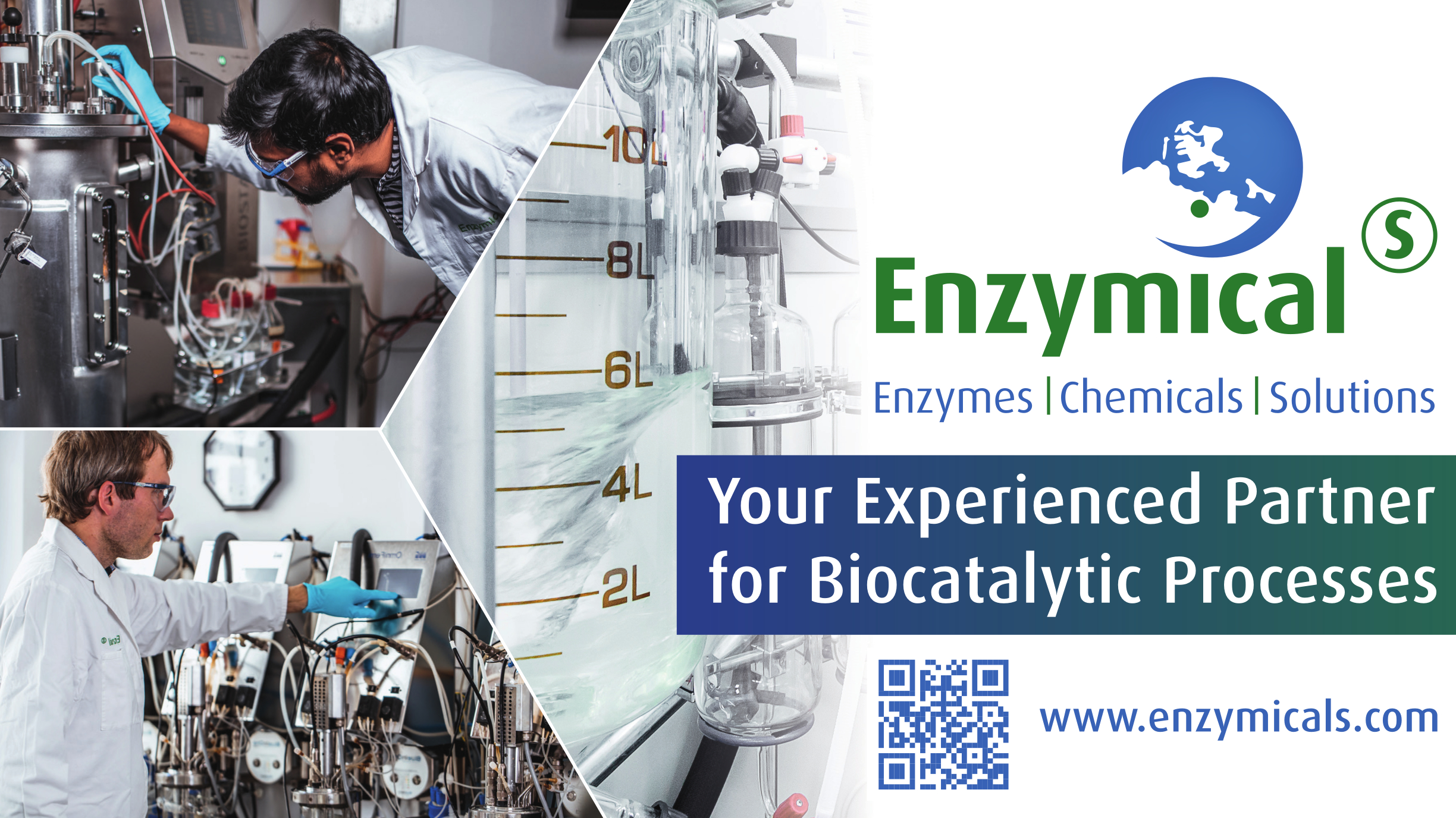
At the heart of this initiative, Enzymicals AG is developing and applying PETase enzymes to enhance PET degradation under industrially relevant conditions. As a leading partner with more than a decade of experience in enzyme discovery, biocatalysis, and process design, Enzymicals focuses on tailoring biocatalysts that efficiently break down PET at practical processing temperatures, bridging the gap between laboratory research and scalable applications.
A Step Toward Industrially Feasible Enzymatic PET Hydrolysis
Enzymatic PET hydrolysis has gained momentum as a sustainable alternative to chemical recycling. PETase enzymes act as molecular scissors, cutting PET into its monomers—terephthalic acid (TPA) and ethylene glycol (EG)—without the need for extreme heat or aggressive chemicals.
However, low enzyme efficiency and thermal stability remain challenges for large-scale applications for some of the developed enzymes. Enzymicals AG is addressing these hurdles by identifying, optimizing, and producing PETases that operate at elevated temperatures suitable for industrial processing. Higher thermal stability enhances polymer breakdown, improving efficiency and reducing processing costs.
“Our approach isn’t just about degrading PET—it’s about demonstrating the feasibility of enzymatic recycling at kg-scale and paving the way for its integration into a circular bioplastic economy,” explains Dr. Rainer Wardenga, Head of Business Development at Enzymicals AG.
Preliminary trials indicate that Enzymicals’ PETases show significant performance improvements over existing benchmarks, bringing enzymatic PET hydrolysis closer to industrial feasibility. In parallel, CETEC in Murcia, Spain, has refined extrusion and quenching methods to enhance PET amorphization, ensuring greater enzyme accessibility and faster degradation rates.
While the French company Carbios is advancing enzymatic PET recycling with the construction of the world’s first PET biorecycling plant, its primary focus remains on recycling PET back into PET. The upPE-T project, however, takes a broader approach by transforming PET waste into PHBV, a biodegradable alternative with applications in sustainable materials.

From Plastic Waste to PHBV: A New Circular Economy Model
The upPE-T concept integrates enzymatic PET hydrolysis with microbial fermentation, using PET-derived monomers as a carbon source for selected microbial strains capable of converting these compounds into PHBV. Unlike conventional PHBV production, which relies on sugar-based feedstocks, this approach directly repurposes plastic waste—offering a more sustainable, non-food-competing alternative.
To streamline the process, a tailored PET hydrolysis approach is being investigated to enhance resource efficiency and support microbial growth. This innovation reduces process complexity and enhances overall resource efficiency.
PHBV is gaining traction in industries seeking biodegradable plastic alternatives, particularly in packaging, agriculture, and biomedical applications. However, further optimization is needed to improve production yields and ensure economic viability before the technology can be scaled for industrial adoption.
“The potential impact is significant—not just in reducing plastic waste, but in creating a true circular economy where PET is not only recycled but repurposed into fully biodegradable materials,” says Dr. Wardenga.
Next Steps: From Research to Real-World Application
The upPE-T project is in an advanced research phase, focusing on further enzyme optimization, process integration, and economic feasibility. Enzymicals AG is actively engaging with industry stakeholders, including packaging manufacturers, waste management companies, and bioplastics producers, to explore potential pathways for scaling enzymatic PET upcycling.
The project’s latest findings will be presented in a final webinar this April, where professionals from industry and academia will discuss enzymatic PET upcycling, PHBV production, and its potential role in future plastic waste management strategies.
For those interested in collaborating or learning more, the webinar provides an opportunity to engage with the scientists and industry experts who are driving this research forward.

Register for the Webinar: Soon on upPE-T webpage

Learn more about upPE-T: https://www.uppet.eu/

Enzymicals AG: https://www.enzymicals.com/

upPE-T project has received funding from the European Union’s H2020 Programme for research, technological development and demonstration under H2020-NMBP-TR-IND-2020-twostage. Grant Agreement 953214
Enzymicals AG
Enzymicals AG specializes in industrial biocatalysis, focusing on enzyme technology, sustainable chemical processes, and scalable biotechnological solutions. The company’s expertise spans pharmaceuticals, specialty chemicals and bioplastics, with an emphasis on circular economy innovations.
Authors:
- Dr. Rainer Wardenga – Head of Business Development, Enzymicals AG
- Dr. Friedemann Leipold – Senior Research Scientist, Enzymicals AG
Leave a Reply