
Last September the DOE had selected eight projects to negotiate for up to 15 M$ under this program.
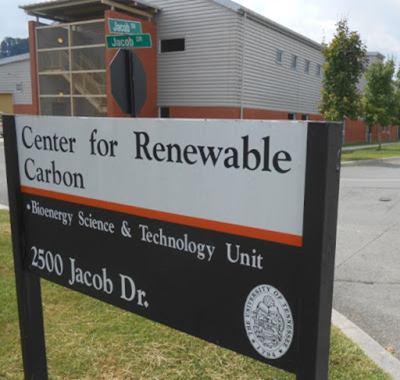
Now, the NIFA has just awarded a grant to the Center for Renewable Carbon at the University of Tennessee through the same program.
The objective of the three stage program is to develop integrated pathways for the extraction of value-added polymeric products from lignin waste/under-valued stream from biorefinery.
A lignin stream from an organosolv bio-refining process will be converted into acrylonitrile-butadiene-lignin (ABL) to directly replace petroleum based plastics used in today’s market.
First stage: the extraction should allow to isolate biomass constituents (cellulose, hemicellulose and lignin) cost efficiently via organosolv fractionation, a process using organic solvent at relatively low temperature and pressure) in order to recover lignin with a yield superior to 70% and a purity superior to 90%
Second stage: the development and commercialization of lignin-cased bioplastics of adhesives with engineered properties at competitive costs with buildings’ siding as main target application.
Third stage: the complete assessment of the integrated bio-refining process comprising a techno-economic analysis and a Life Cycle Analysis from cradle to grave.
The partners to the programs are:
- The Center for Renewable Carbon at the University of Tennessee (UT-CRC).
- The Oak Ridge National Laboratory (ORNL).
- The Natural Resources Research Institute at the University of Minnesota (NRRI).
- The American Science and Technology Corporation (AST),
- The University of Wisconsin Stevens Point (UW-SP).
- The Long Trail Sustainability (LTS).
- Advanced Lignin Biocomposites LLC (ALB-LLC).
The grant of 3 million USD was awarded by NIFA’s Agriculture and Food Research Initiative (AFRI), which addresses challenges in food and agricultural sciences through research, extension and education.
RELATED ARTICLES
Discover all our articles on Lignin